The home of bohra
Comprehensive sequence characterisation for microbial genomics - Documentation under contruction - thank you for your patience.
The bohra pipeline is designed to be flexible and modular, allowing for inputs from paired-end fastq and/or assemblies, with direct support for ONT coming soon.
Stand alone html reports are generated for easy sharing and visualisation of the results.
Usage instructions can be found here
Installation
Recommended (conda or mamba)
1. Install conda (skip this step if you already have conda installed)
If you do not already have conda installed, you can check out the documentation here. We recommend you install miniforge
2. Create and install bohra
mamba (or conda) create -n bohra -c bioconda bohra
3. Install dependencies and setup databases
conda activate bohra
bohra deps install
Details of database setup and other options for installation can be found here
Motivation
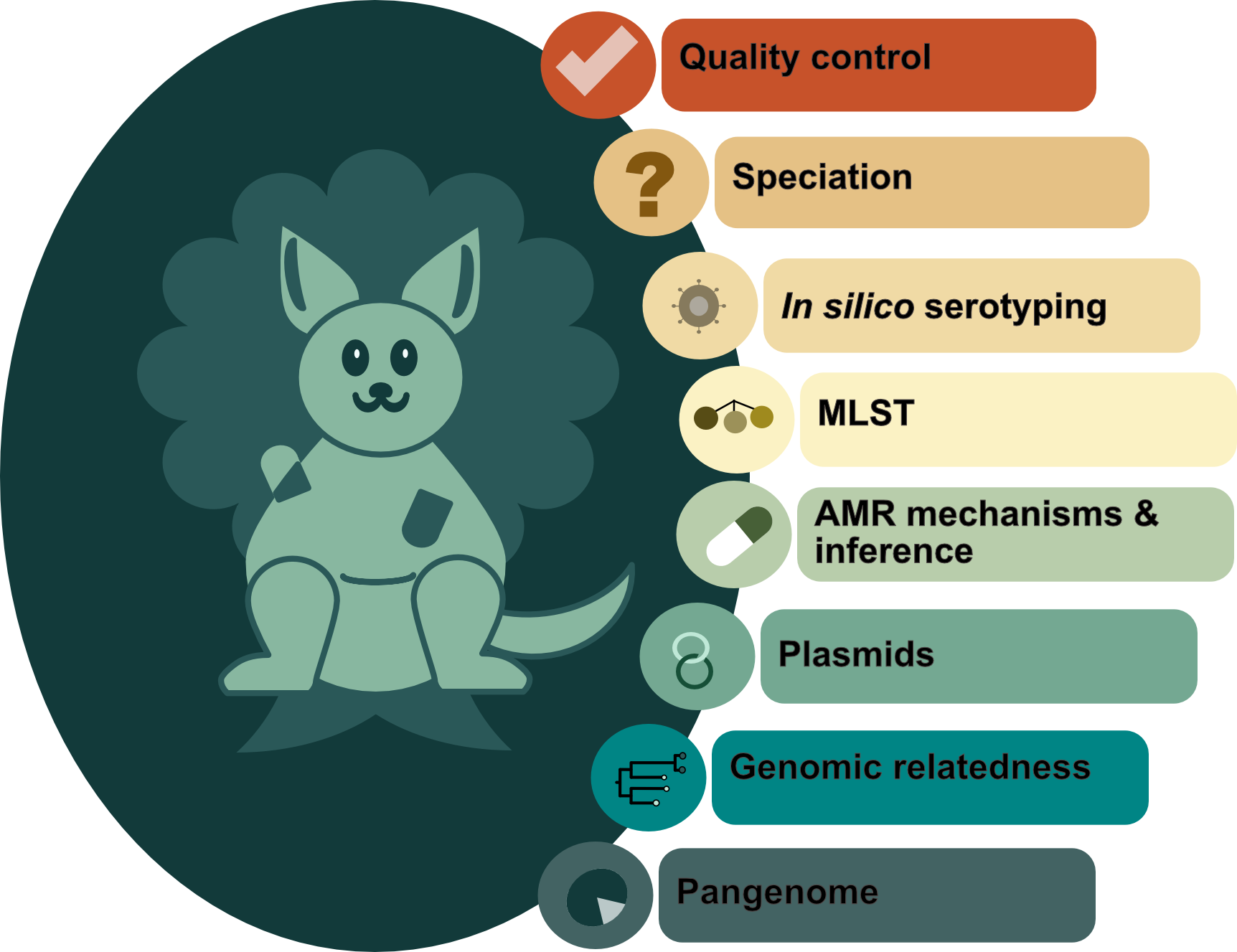
bohra is microbial genomics pipeline, designed predominantly for use in public health, but may also be useful in research settings. It leverages existing high quality bioinformatics tools, to provide users with an easily accessible report of comprehensive analysis results of bacterial sequence data to for characterisation of single samples or for outbreak investigations or population studies.
- Quality assessment of the input data
- Speciation and appropriate in silico serotyping (where applicable).
- MLST
- Species relevant recovery of AMR mechanisms and inference of genomic AST/DST were available (S. enterica and M. tuberculosis).
- Plasmid information
- Comparative analysis using a reference-free or reference-based appproaches.
- Pangenome analysis.
Etymology
The name 'bohra', is the name of an exinct species of tree kangaroo that lived on the Nullarbor plain in Australia and was chosen to reflect the fact that it was originally developed to used to build trees, relies on snippy (named for a very famous kangaroo) and was inspired by nullarbor.